IEU brings evidence, learning, and country-led insights to COP30
-
Authorship
Therese Gonzaga
![]()
Communications Consultant - Article type News
- Publication date 30 Nov 2025

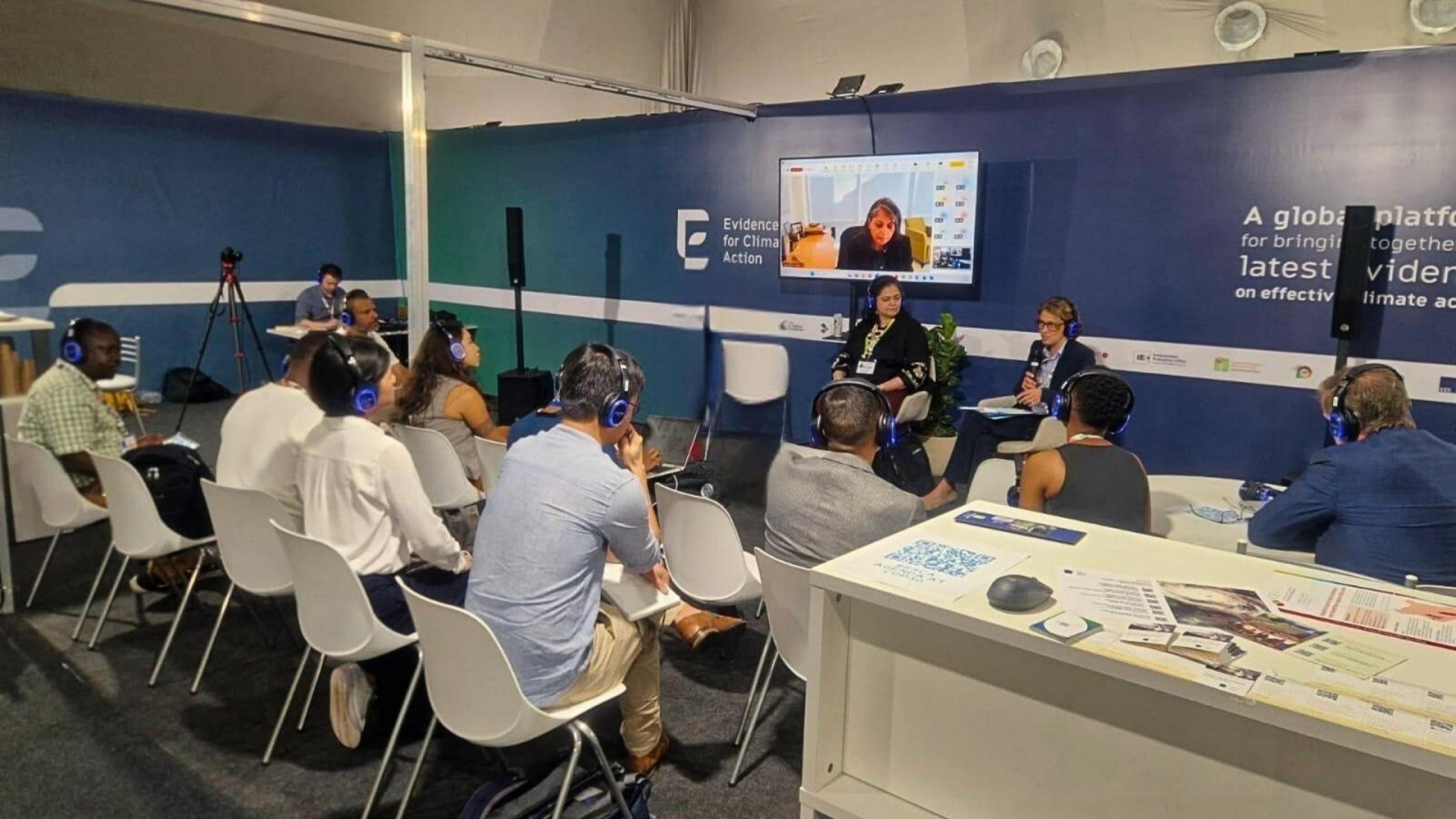
Through eleven sessions across COP30, the Independent Evaluation Unit shared findings from its recent and ongoing evaluations, joined cross-fund discussions, and highlighted the role of evidence in strengthening climate finance.
The Independent Evaluation Unit (IEU) of the Green Climate Fund took part in eleven sessions at COP30 through a mix of virtual and in-person events. These included engagements at the Evidence for Climate Action (E4CA) Pavilion, joint Climate Funds discussions, and partner-led sessions throughout both weeks of the conference.
COP30 outcomes and relevance to IEU’s work
In the broader context of COP30, Parties agreed on new guidance to the Green Climate Fund that closely aligned with themes reflected in the IEU’s recent evaluations. The decision text urged the Fund to simplify access modalities, strengthen direct access (including for Indigenous Peoples), uphold country-driven approaches, and enhance partnerships with the private sector.
It also reaffirmed the central role of national designated authorities and encouraged continued capacity-building for direct access entities. Negotiators further called for an updated gender action plan for the Fund, to align with the Belém Gender Action Plan for 2026–2034. These priorities resonate with findings from the IEU’s evaluations on Indigenous Peoples and Country Ownership.
Presenting evidence from recent evaluations
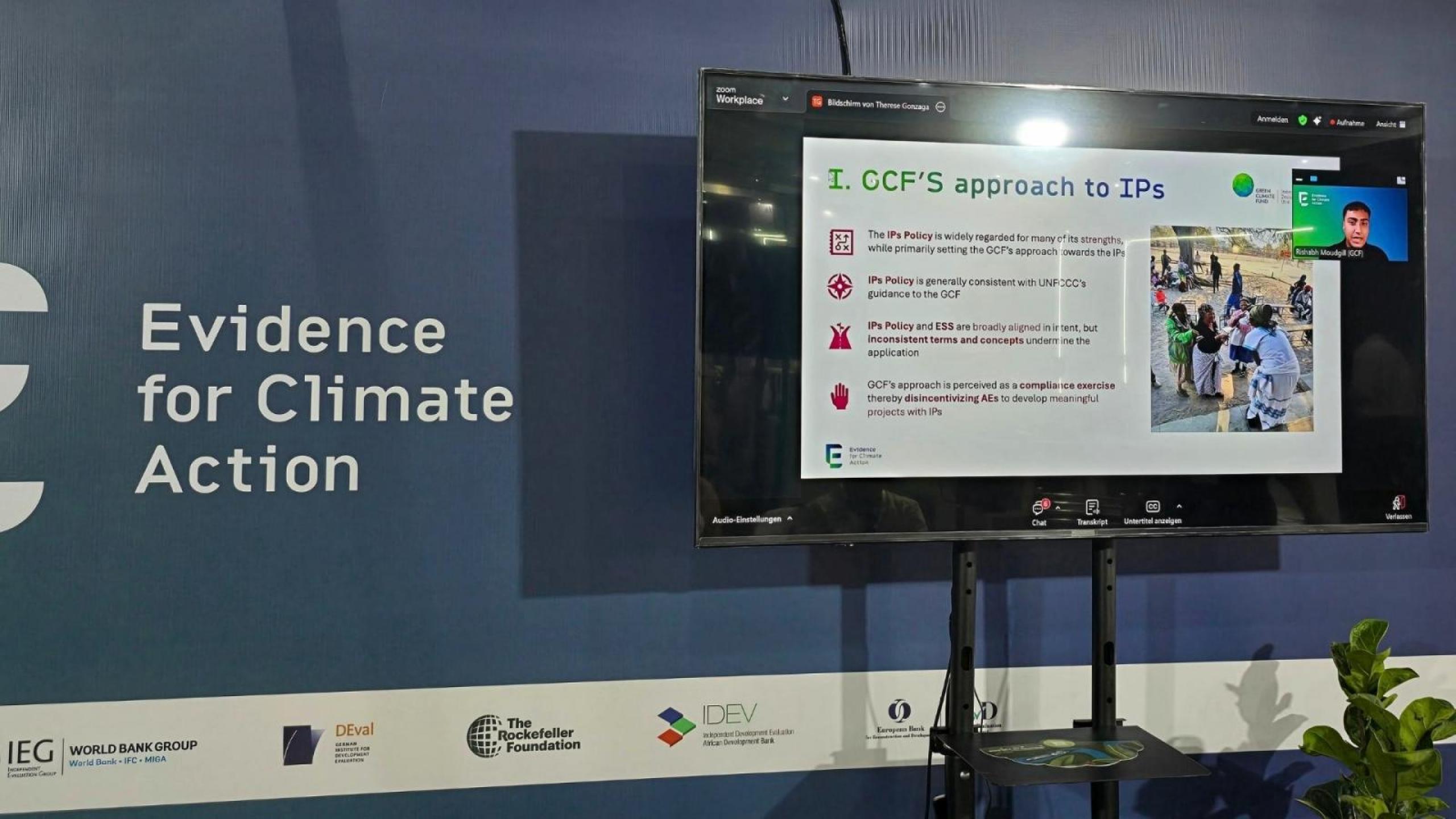
Across the programme, the IEU shared findings from its recent and ongoing evaluations, including studies on Indigenous Peoples, country ownership, GCF’s investments in Latin America and the Caribbean, and the Fund’s performance reviews.
A key moment was the IEU’s virtual flagship session on Indigenous Peoples. Genta Konci, Evaluation Specialist, and Rishabh Moudgill, Policy and Evaluation Specialist, presented the evaluation’s findings and recommendations, discussing participation, safeguards, and the importance of Indigenous leadership in climate action.
Country platforms and country-led evaluation
At the Climate Funds Pavilion, Yeonji Kim, Evaluation Uptake Specialist, contributed to the session on programmatic approaches and country platforms. She shared insights from the 2025 Independent Evaluation of the GCF’s Approach to Country Ownership, highlighting that ownership often remains procedural and underscoring the need for stronger national systems, coordination, and country platforms built around country needs (full video here).
Later in the week, Rishabh Moudgill presented findings from the same evaluation during the IEU’s virtual E4CA session.
Regional evidence and performance reviews
In another virtual session, Jeehyun Yoon, Evaluation Specialist, shared lessons from the Independent Evaluation of the GCF’s Investments in Latin America and the Caribbean, including insights on relevance, regional engagement, and effectiveness.
At the cross-fund panel on performance reviews of climate funds, the IEU joined evaluation leaders from the Global Environment Facility and the Adaptation Fund, together with the UNFCCC Secretariat.
The session featured contributions from Dr. Geeta Batra (GEF Independent Evaluation Office), Debbie Menezes (Adaptation Fund Technical Evaluation Reference Group), and Sophie De Coninck (UNFCCC Secretariat), alongside reflections from the IEU, presented by Dr. Archi Rastogi, Chief Evaluation Advisor.
The discussion brought together findings from ongoing and completed performance reviews and explored how climate finance institutions can evolve to better meet future needs across the Financial Mechanism.
AI, resilience, and sector-level discussions
In the cross-fund session on artificial intelligence in evaluation, Alejandro Gonzalez-Caro, Evaluation Data Associate, discussed how the IEU is testing AI tools to support large-scale document review and structured evidence work, while underlining the need for careful oversight and responsible use (full video here).
The IEU also contributed to thematic discussions across COP30. At the Evidence Pavilion, speakers from the GEF, Adaptation Fund, and IEU examined lessons from financing forestry programmes. The Unit also joined the external side event Forests, Finance & Fairness with the Center for International Forestry Research (CIFOR), where Andreas Reumann provided a pre-recorded contribution. In the Moana Blue Pavilion, Andreas also shared reflections in the resilience session through a pre-recorded presentation, contributing evidence on adaptation and climate resilience.
The programme further included a session led by the United Nations World Food Programme, where Jennifer Waidler presented evidence from integrated resilience and food security interventions. Marco d’Errico, Impact Evaluation Officer, offered reflections from the GCF perspective and linked these to the IEU’s work on climate resilience.
Bringing evaluation into climate finance discussions
Together, these engagements highlighted how the IEU brings credible, independent evidence into climate finance discussions, contributing to stronger learning, accountability, and support for country-driven climate action across the UNFCCC process.