About us
The Independent Evaluation Unit (IEU) ensures GCF is accountable and effectiveThe IEU's 2026 Work Plan and Budget
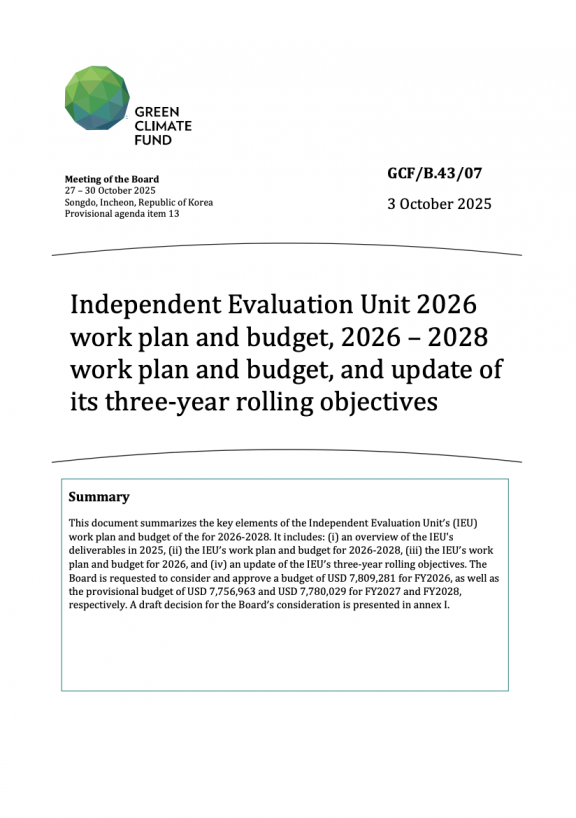
At its forty-third meeting in October 2025, the Board of the Green Climate Fund (GCF) approved the IEU’s 2026 work plan and administrative budget, 2026-2028 work plan and provisional administrative budget, and noted the update of the IEU’s three-year rolling objectives (B.43/13). The IEU’s work plan for 2026 is aligned with its three-year rolling objectives and focuses on the delivery of independent evaluations, evaluation-based learning, advisory activities, and institutional strengthening to support accountability and learning for the Board of the GCF.
The IEU’s work plan for 2026 is structured around four strategic objectives, ensuring the delivery of high-quality evaluations, evaluation-based learning and advisory activities, strategic engagement, and institutional strengthening.
IEU’s Strategic Objectives for 2026
- Objective I: Undertake and deliver high-quality evaluations to the Board of the GCF.
- Objective II: Build and deliver evaluation-based learning, advisory, and capacity-strengthening programme.
- Objective III: Engage strategically to learn, share, and adopt best practices in the climate change evaluation space.
- Objective IV: Strengthen and position the IEU within the Fund and in its ecosystem.
Key Evaluations in 2025
- Third Performance Review of the GCF - Assessing the GCF’s performance during the second replenishment period (GCF-2) to inform a review of the GCF’s strategic plan and replenishment process for GCF-3.
- Independent evaluation of the GCF’s approach to gender - Assessing GCF’s approach to gender and the extent to which gender sensitivity, responsiveness, transformation, and outcomes have been incorporated both in the GCF’s support programmes and project cycle.
- Independent Evaluation of the GCF’s Approach to and Portfolio of Private Sector Engagement - Assessing the relevance, coherence, and effectiveness of the GCF’s private sector engagement, including the Private Sector Facility, across instruments, policies, partnerships, and the project cycle.
- Independent Evaluation of the GCF’s Approach to Ecosystems, Ecosystem Services, and Biodiversity - Assessing the GCF’s approach to ecosystems, ecosystem services, and biodiversity, with a focus on climate change adaptation and ecosystem-based approaches across the portfolio.
- Independent Evaluation of the Green Climate Fund’s Project Preparation Facility (PPF) - Assessing relevance, coherence, and effectiveness of GCF’s PPF and the extent to which it is fulfilling its intended objectives to support Direct Access Entities (DAEs) and develop micro and small projects to promote portfolio balance and diversity.
- Independent Evaluation of the GCF’s Readiness and Preparatory Support Programme (RPSP) - Assessing the effectiveness, efficiency of the revised RPSP strategy for 2024–2027 and key factors driving the impact and sustainability of the strategy.
- Impact evaluations - Guiding, assisting, and advising impact assessments (LORTA) for an identified group of GCF-funded activities. In 2026, the IEU plans to make progress with the four impact evaluations, which include FP034 (Uganda), FP101 (Belize), FP072 (Zambia), and FP073 (Rwanda).
The IEU will also continue the Learning-Oriented Real-Time Impact Assessment (LORTA) programme, which supports impact evaluations of GCF-funded activities.
Evaluation-Based Learning and Advisory Work
The IEU will continue its evaluation-based learning, knowledge and synthesis activities, advisory support, capacity-building, and quality assurance functions to support the use of evaluation evidence in decision-making, in line with the IEU’s mandate under the GCF Evaluation Policy.
In 2026, the synthesis on forest-based climate action and REDD+ will consolidate global and Fund-level evidence and respond to the growing relevance of the topic in the GCF portfolio, following the Board’s decision to mainstreaming of REDD+ RBP at B.40.
To attest to the quality of the self-evaluations by the AEs and Secretariat, the IEU will continue to undertake periodic evaluability assessments of GCF’s Funding Proposals and quality assessment of AE-led project evaluations.
Lastly, the IEU will continue to strategically engage with the evaluation offices and networks, including four climate funds (GEF, AF, CIF), UNEG, and global SDG synthesis coalition.
Institutional Strengthening and Positioning
The IEU will continue to strengthen its institutional effectiveness and positioning in the Fund and its ecosystem. The work plan includes implementation of the Evaluation Policy and preparations for its future review, and the management action reports to assess the Secretariat’s progress in implementing IEU’s recommendations.
All documents
| Title | Date |
|---|---|
|
B.46 Activity Report |
08 Oct 2026 |
|
IEU Work Plan and Budget for 2027 |
08 Oct 2026 |
|
B.45 Activity Report |
17 Jun 2026 |
|
B.44 Activity Report |
25 Mar 2026 |
|
Annual Report 2025 |
18 Mar 2026 |
|
IEU Work Plan and Budget for 2026 |
13 Jan 2026 |
|
B.43 Activity Report |
27 Oct 2025 |
|
B.42 Activity Report |
10 Jun 2025 |
|
IEU Work Plan and Budget for 2025 |
25 Feb 2025 |
|
Annual Report 2024 |
14 Feb 2025 |
|
B.41 Activity Report |
03 Feb 2025 |
|
B.40 Activity Report |
03 Oct 2024 |
|
B.39 Activity Report |
24 Jun 2024 |
|
Annual Report 2023 |
22 Feb 2024 |
|
IEU Work Plan and Budget for 2024 |
20 Oct 2023 |
|
B.37 Activity Report |
17 Oct 2023 |
|
B.36 Activity Report |
19 Jun 2023 |
|
Annual Report 2022 |
23 Feb 2023 |
|
IEU Work Plan and Budget for 2023 |
25 Oct 2022 |
|
B.34 Activity Report |
26 Sep 2022 |