Evaluation perspectives on country ownership shared across multilateral climate funds
-
Authorship
Therese Gonzaga
![]()
Communications Consultant - Article type News
- Publication date 24 Feb 2026

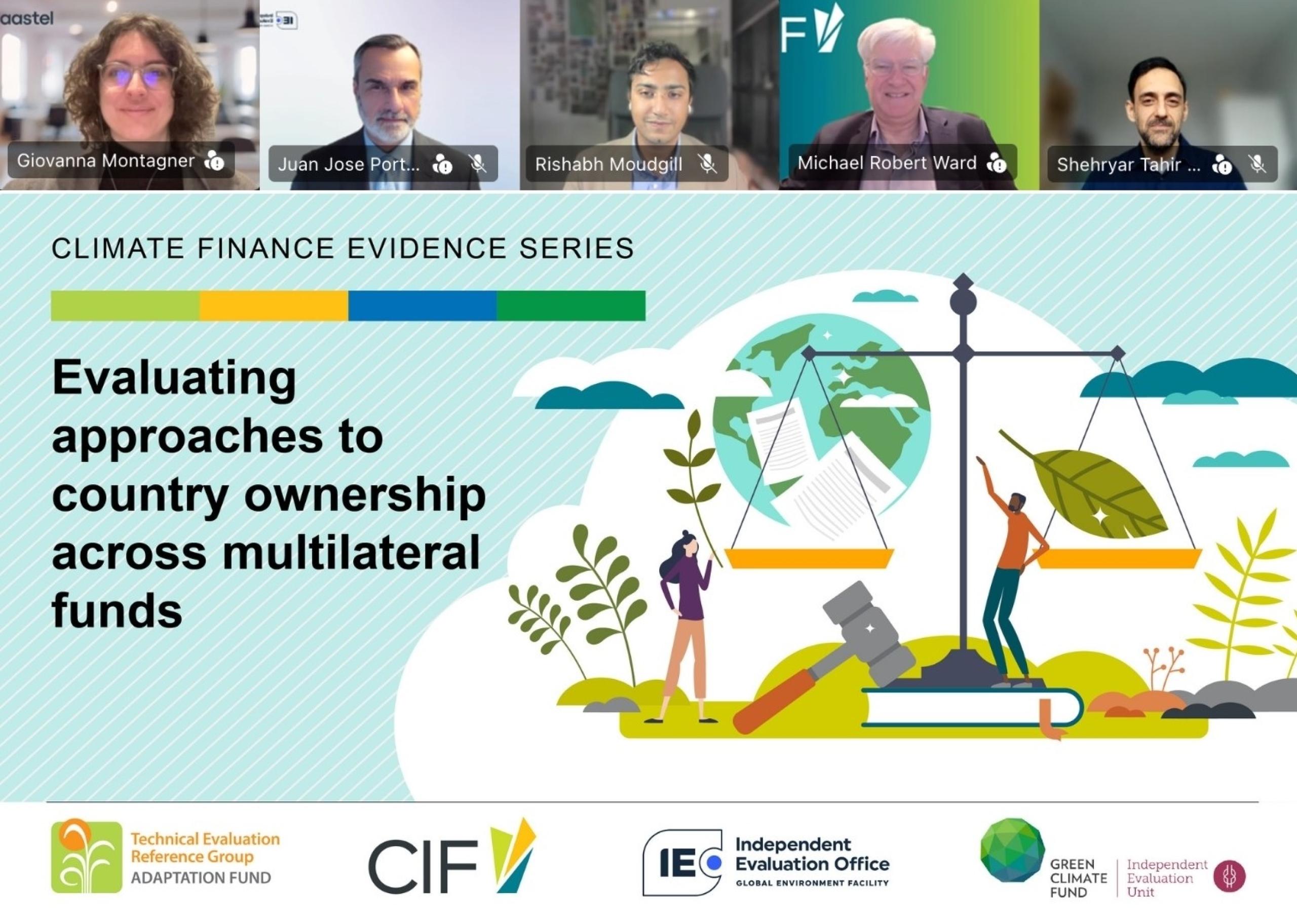
On 12 February 2026, the Independent Evaluation Unit of the Green Climate Fund hosted a webinar examining how country ownership is defined, operationalized, and sustained across multilateral climate funds.
The session was held under the Climate Finance Evidence Series, a joint initiative aimed at strengthening collaboration and learning across the evaluation functions of the Global Environment Facility, the Adaptation Fund, the Climate Investment Funds and the Green Climate Fund.
Moderated by Giovanna Montagner, climate finance and evaluation consultant with Baastel, the discussion brought together evaluation leaders from the four funds to share recent and ongoing findings.
Green Climate Fund: ownership beyond procedural signals
Rishabh Moudgill, Policy and Evaluation Specialist at the Independent Evaluation Unit of the Green Climate Fund, presented findings from the IEU’s evaluation of the GCF’s approach to country ownership, which is scheduled for submission at the Forty-Fourth Meeting of the GCF Board.
The evaluation finds that the GCF does not operate with a single fixed definition of country ownership. Instead, the concept is reflected across multiple policies and operational instruments.
It cautions against relying on procedural signals, such as no objection letters, as evidence of meaningful ownership. Government endorsement does not automatically translate into sustained national influence throughout the project cycle.
To clarify the concept, the evaluation proposes a three-layer framework covering macro conditions, structural arrangements, and cultural dynamics crucial for deciphering and monitoring country ownership. Country ownership is framed as a “quality of the system”, rather than a characteristic of individual projects, which can weaken during implementation unless it is actively reinforced over time.
Climate Investment Funds: country platforms and alignment
Michael Ward, Head of Evaluation and Learning at the Climate Investment Funds, shared lessons from CIF’s programmatic approach to country-led climate investment planning.
Since 2008, CIF has used country-led investment plans developed with support from partner multilateral development banks, enabled by multi-year resource envelopes, and enhanced by cross-ministerial coordination and stakeholder engagement.
Evaluative evidence highlights stronger strategic coherence and alignment with national priorities, while also noting that ownership can weaken during implementation as focus shifts back to individual projects. Sustained coordination, institutional continuity, and adaptive learning systems were identified as critical to maintaining ownership over time.
Adaptation Fund: direct access and capacity constraints
Shehryar Tahir Janjua, senior member of the Technical Evaluation Reference Group of the Adaptation Fund, discussed how the Fund’s direct access modality shapes country ownership.
By accrediting national institutions to directly access funding, the Adaptation Fund seeks to strengthen national systems and decision-making authority. Evaluations show that while direct access can enhance institutional capacity, sustaining ownership depends on stable institutions, inclusive engagement, and long-term capacity development.
Ownership, in this context, is closely tied to institutional strength and the ability to maintain engagement beyond individual projects.
Global Environment Facility: country engagement and portfolio alignment
Juan Jose Portillo, Senior Operations Officer at the Independent Evaluation Office of the Global Environment Facility, reflected on findings from the evaluation of the GEF’s Country Engagement Strategy, conducted as part of the Eighth Comprehensive Evaluation of the GEF.
The evaluation finds that the strategy has contributed to improved alignment with national priorities, broader stakeholder engagement through national dialogues, and greater visibility of GEF programming at country level. At the same time, it identifies the need for more frequent and diversified capacity building through a mix of in-person activities, virtual training, and outreach, as well as to strengthen operational management, coordination with other funds, and policy coherence support.
Long-term engagement with national focal points remains central to reinforcing country ownership across programming cycles.
Shared challenges and continued collaboration
Across the discussion, speakers emphasized that country ownership is not a static condition. It is shaped by institutional authority, incentives, capacity, and long-term partnerships.
Recurring themes included the risk of ownership weakening during implementation, variability in national capacity, and the need to strengthen interoperability across funds in areas such as planning alignment, capacity development, stakeholder engagement and monitoring and evaluation systems.
The webinar highlighted the value of cross-fund dialogue in identifying common challenges and advancing coordination in the delivery of climate finance.
The full recording of the webinar is available below: