FP068
Scaling-up multi-hazard early warning system and the use of climate information in Georgia
Scaling-up multi-hazard early warning system and the use of climate information in Georgia
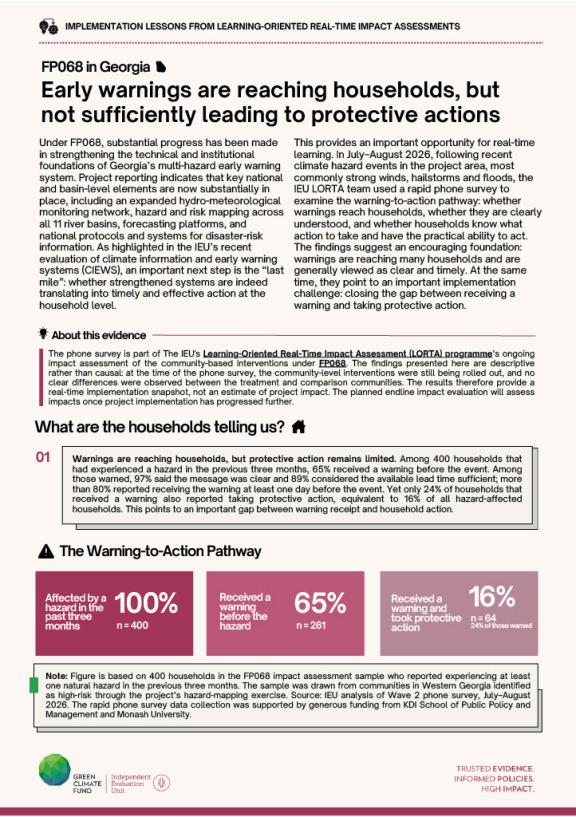
This evaluation aims to assess the impact of the FP068 "Scaling-up Multi-Hazard Early Warning System and the Use of Climate Information in Georgia" on vulnerable populations in flood-prone areas of Georgia. This UNDP project seeks to develop a proactive, integrated climate risk management approach by establishing a nationwide Multi-Hazard Early Warning System (MHEWS) and incorporating climate information into planning and decision-making processes. The impact evaluation specifically examines the impact of two sub-components of the project, Community-Based Early Warning Systems (CBEWS) and Community-Based Climate Risk Management (CBCRM), on household's resilience against climate shocks.
-
TopicTo be determined
-
Project componentImplementation of CBEWS and community-based climate risk management (CBCRM)
-
Impact evaluation designRandomised Control Trial (RCT)
-
Target beneficiaries52 per cent of 258,841 beneficiaries are expected to be women. The baseline data collection achieved a sample size of 2,103 households, including 1,065 interviews in the treatment group and 1,038 interviews in the control group.
Timeline
Onboarded to LORTA
Jul 2018
Baseline data collected
Dec 2023
Baseline report to be published
Sep 2024
Endline report to be published
Jul 2027
One region
- Eastern Europe
One country
- Georgia